How to Afford Food, Together
By: Sam Butler
Editor: Jenna Jablonski
If city-owned grocery stores or any other affordability solution are going to lower the cost of food, they must address the costs of overhead (rent, maintenance, payroll) that contribute to shelf prices.
Some solutions like buying clubs and mobile market trucks operate without brick-and-mortar locations at all — lowering costs to pay what you can.
According to a December report, 68% of people are struggling to afford food.
That's before a recession.
What is the solution?
Some point to Mamdani's public grocery store plan in New York City. Others point to food cooperatives. Others suggest increasing the supply and competition of grocery stores.
If any of these approaches are to lower the prices we're paying, they have to address a key cost: overhead.
Farm Stop is a locally owned grocery store model in Michigan that sells food delivered directly from farms — no wholesalers or distributors. Cutting out the middle-man allows them to give more money back to farms.
But their prices aren't cheaper for people.And the same can be true for food cooperatives and community-owned grocery stores. Even when they're locally-owned — even owned by the customers themselves — they aren't necessarily cheaper than corporate grocery stores.
The problem? A commercial real estate lease, with utilities, refrigeration, maintenance, and payroll, is expensive to maintain. And all of that adds to the cost of food on the shelf.
Even during peak profits in 2020, the grocery industry — led by chains seeking to maximize profits from customers — still only had a profit margin of 3%. Amidst the unaffordable prices today, the grocery industry now only has a profit margin of 1.8%.
Brick-and-mortar stores, no matter who owns them, only have so much room to lower prices when they're paying for rent, maintenance, lighting, utilities, and payroll.
The same reality will apply to Mamdani's public grocery stores. Mamdani has a key plan to address this in New York: using publicly owned buildings where the city doesn't have to pay rent.
But what if your city doesn't have access to publicly-owned, rent-free buildings to lower grocery costs?
You'll have to find other ways to bring down the costs of food.
Taking out the overhead
Consider Farm Stop again. They receive orders directly from farms, cutting out middle-men, in order to give more value to those farms. Consumers can do the same thing — order directly from farms and producers, cutting out the overhead from buying at the store.
But a farm won't just deliver you two cartons of eggs at the same price they sell to Farm Stop. To get that price, you have to order larger quantities like a store does. This is called wholesale.
Wholesale comes in quantities like a 20-lb case of apples or a 10-lb case of carrots. Unless you're going to eat all of that yourself, you would typically make a wholesale order with a group of people — called a buying club.
With 5, 10, or 30 people, you can order directly from a farm or producer — putting together a large enough order for a standard delivery at the same price the store gets.
Now, you and your fellow community members are buying food without the overhead of a grocery store — the rent, the utilities, the payroll — and paying 30-75% less.
Retail experts may tell you that store markup is closer to 40% — and that may be true for many items.
But we've gotten price lists for staple foods like produce and pantry items from farms and producers and compared them directly to prices on the shelf.
Apples for $1 per lb instead of $3 per lb (66% less). Carrots for $2.20 per lb instead of $3.50 per lb (37% less). Heads of lettuce for $1.33 instead of $2.99 (55% less). White mushrooms for $3.99 per lb instead of $7 per lb (43% less). Green beans for $1.8 per lb instead of $5.25 (65% less). Sauerkraut for $1.80 per lb instead of $7.50 (76% less).
When you're saving that much money on food through large group orders, you can even make it affordable for everyone in a community: paying what you can.
Pay What You Can
Last October, across the street from an empty lot once promised to be a grocery store in Washington, DC, we did just that.
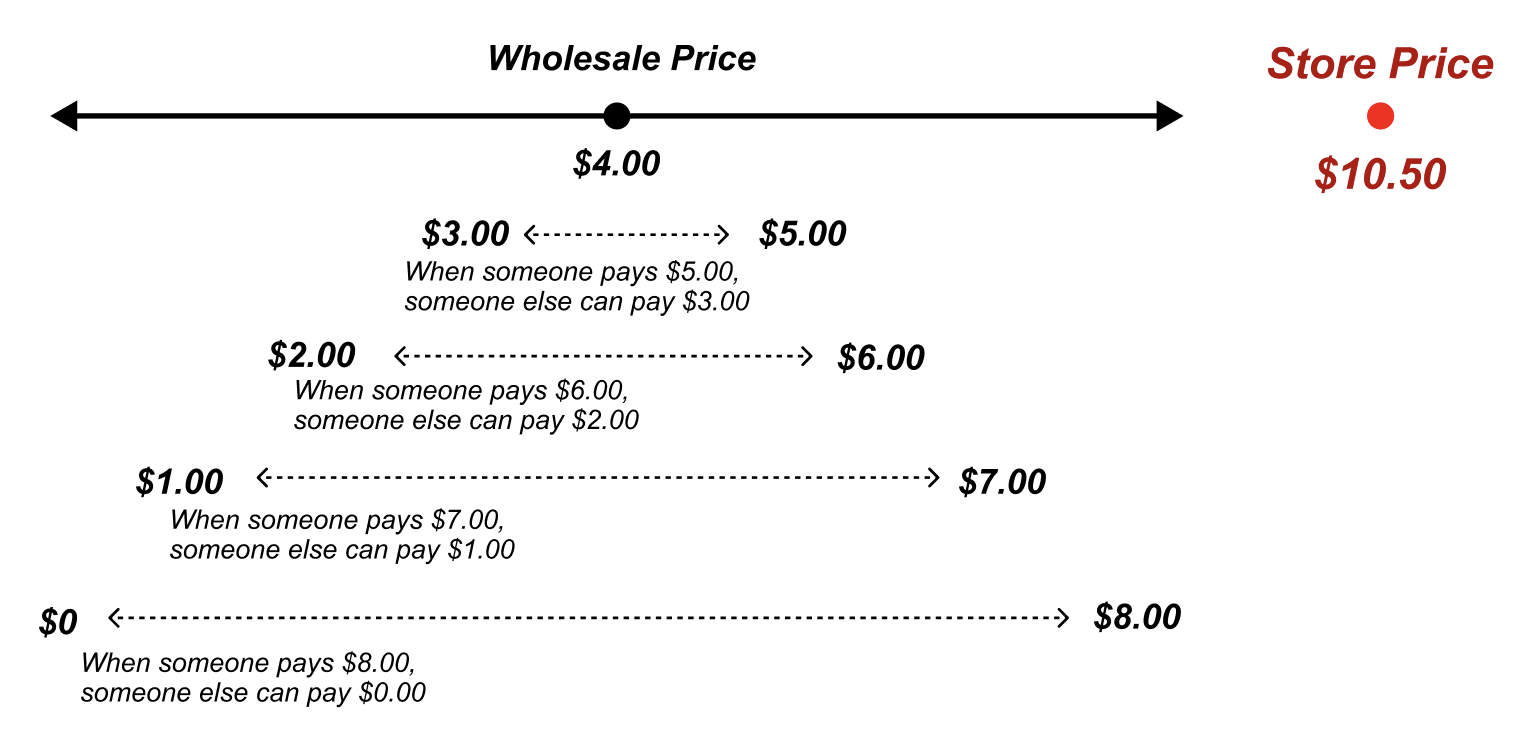
We contacted a local farmer with healthy, pasture-raised eggs, and asked about wholesale prices. His eggs were the kind that would cost $10.50/dozen at the grocery store or farmer's market (if you're lucky.) Our price for a $500 order? $4.00/dozen — delivered right to us.\ A new possibility emerged in front of us: If we could save that much compared to store prices, we didn't need to ask $4.00/dozen at distribution. We all could pay what we can.
For example, some people can easily afford to pay $6 or $7 or $8 for healthy, organic eggs. Some people can afford $1 or $2, or nothing at all.
But for every person who paid $6 for a carton — still 45% off the store price ‑ another person could pay $2. For every person who paid $7 — 35% off the store price — another person could pay $1. For every person who paid $8 — 25% off the store price — another person could take a carton and pay nothing at all.
And everyone benefits from the larger order — even those who pay the highest prices, still pay less than they would at the store.
Imagine what happens when everybody is saving money on food like this, every week. The parent who couldn't pay anything for eggs could maybe eventually pay $1 or $2. The person who could afford $4 might eventually be able to pay $6, with savings adding up. The person who paid $8 might eventually afford $10 and pass it on.
And that means a lot more people can start joining these orders, with whatever they can afford to pay — which means a lot more orders for farms, and a lot more food for people.
How? By cutting out the overhead.
A buying club isn't the only way. Besides opening stores in rent-free buildings, you can get similar benefits from a mobile food truck (like Fresh Truck in Massachusetts), which also operates with significantly less overhead than a brick-and-mortar store. You can also look at other ways to lower overhead, like food coops such as Park Slope Food Co-op in Brooklyn, which use volunteers to lower staff needs and offers 25% discounts as a result. (Park Slope is a best-case scenario with this model, requiring members to only work 2.75 hours every six weeks to be eligible for discounts — many co-ops require far more than that, like 2 hours per week). But even then, what is the timeline to getting cheaper food? It takes months to organize a coop — and months to years get a building for it.
The Store Theory
It's all about how much you're willing to pay a store to, well, store food. Take out the need to access a store 7 days a week, with a full payroll, and the whole equation changes
No store for food
Full store
|
Direct to Consumer (Individually Shipped Orders to Homes) |
Buying Club (Group wholesale order to neighborhood) |
Mobile Food Market |
Food Coop (e.g. Park Slope) |
Public Grocery Store (Rent-free) |
Normal Grocery Store | |
| Access to a store | Delivered to home | No store, but close neighborhood pick-up location | Limited hours / day per location | Full | Full | Full |
| Rent | None | None | None | Full | None | Full |
| Payroll | None | None (some volunteer needs) | Limited (market truck prep and staff) | Low (volunteers support staff) | Full | Full |
|
Item Packaging |
Individual items | Wholesale packaging | Individual items | Individual items | Individual items | Individual items |
|
Item Choice |
Depends on distributor availability |
Full (You can get any item you find a distributor for) |
Medium (Limited by truck space) | Full (You can get any item you find a distributor for) | Large (Less input on items) | Large (Less input on items) |
| Price Savings | None | 30-75% | 20% | 20-40% savings | 20-30% savings | None |
| Start-up Costs | None | Minimal | Market truck, renovations, payroll | Space rental, renovations, equipment, payroll | Renovations, equipment, payroll |
Space rental, renovations, equipment, payroll |
| Financial Risk | None | None | Low | Large | Medium | Large |
| Startup Time (Until People Start Saving) | N/A | 1 week - 1 month to place order | Months - year | Months - years | Months - year | N/A |
What could things look like if we took this logic forward?
In communities that are well served by their grocery stores — with good access, prices, and customer experiences — not much might change. As an example, coops like Park Slope and Takoma Park Silver Spring Food Coop in Maryland offer a great experience for food coop members and customers who can afford shopping there, meaning those people might not need anything new. (Buying clubs could still offer an additional, closer option for food, given that Americans live 3.8 miles from their preferred store and half of all car trips going to grocery shopping and errands, with this kind of sprawl contributing to 30% of global emissions. Closer food options such as buying clubs and mixed-use shops in residential areas will certainly be part of the solution.)
But communities that are being inadequately served — such as low-income, low-access areas (formerly called "food deserts"), or those that have to depend on price-gouging stores like Dollar General (which is looking to expand even further) — may look to buying clubs and mobile food markets instead.
Some may worry about the possibility of grocery stores closing down in the face of closer food options with better prices and services like buying clubs and mobile food markets. However, that wouldn't happen in places that are served well by their current grocer footprint. And in places where it did, that would create new opportunities — such as grocery stores converted into housing, and new jobs in industries such as construction, contracting, masonry, and electrical work, that are much more resilient to automation (and Amazon Fresh stores without cash registers at all).
These choices aren't all or nothing, either.
Alongside public grocery stores, Mamdani and other city leaders (who may not have access to rent-free buildings like New York City has) could invest in other food solutions as well. This could look like training and education to help neighborhoods and apartment buildings start buying clubs, or allocating funds to try publicly-owned mobile food market trucks — before going all-in on brick-and-mortar locations.
Mamdani's proposal to redirect subsidies from corporate grocery chains could help pay for initiatives like these, too.
But you and your neighbors don't need to wait for that to happen.
If you want to save money on food, all you need to do is call up a local farm or producer and see if they'll deliver wholesale to a community group — a buying club. If yes, ask for a price list and a minimum order quantity. Share their items and prices with your neighbors, and start putting in orders to your text group or email list, or use a collective purchasing app, combining orders to reach wholesale-size volumes (e.g. 20 lbs of apples or 10 lbs of carrots). When delivery day comes, you can weigh out and pass out orders with a scale. (Minimal packaging, too!)
That should save you 30-75% off the costs at the store. Across a community, ordering together and saving, maybe that means we all could start affording the costs of food.
We’re raising funds to try wholesale purchasing in a cohort of communities — paying upfront for orders, allowing people to pay what they can, and seeing how that evolves over time.
We're also planning to capture footage of the process, for a documentary-style television program or film and shorter videos in real-time along the way.
Do you want to support all of us affording food — and learning how to do it, together?
If you'd like to fund local food experiments or upfront food purchases, (including possibilities for repayment), we would love to connect. If you'd like to support education or storytelling about this work, we can provide tax-deductible donations through our fiscal sponsor (the Southern Documentary Fund) — we would love to connect on that as well.